for-all-mankind:
Blue Origin tests New Shepard suborbital rocket on maiden flight.
Blue Origin, Jeff Bezos’ space start up, achieved a significant milestone in its goals of space tourism Wednesday, 29 April.
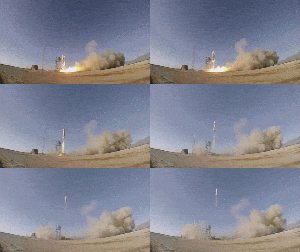
The New Shepard launch vehicle and crew capsule launched from the company’s west Texas launch site in an unannounced test.
Marking
its first all-up flight, New Shepard is a single-stage, suborbital
vehicle designed to loft a crew capsule into sub-orbit. Following
spacecraft separation, the rocket – dubbed the Propulsion Module – would
return for a vertical landing downrange for reuse.
Wednesday’s
test saw the Propulsion Module and Crew Capsule separate nominally,
with the capsule reaching a peak altitude of 307,000 feet – or 58 miles.
However, the successful recovery of the Propulsion Module did not occur
due to a loss of pressure in the landing hydraulic system.
“If New Shepard had been a traditional expendable vehicle, this would have been a flawless first test flight.” Bezos said in a statement post-flight.
New
Shepard utilizes a single BE-3 engine to loft the vehicle uphill. The
company is also working on creating the BE-4 engine for ULA as a
domestic replacement for the Russian-made RD-180 engine.
In the
images above, New Shepard can be seen lifting off from the company’s
test stand in Texas. The second image shows the Propulsion Module from
the crew module shortly after separation – with Texas 56 miles below.
Video Highlights of the launch can be seen here, with a longer tracking camera video of the flight, including the capsule’s landing, here.



 GigiopixTumblr