Dottore, mi capita di prendere l’oki 4 o 5 volte al mese in media per dolori vari ed eventuali (mestruazioni, cervicali). Sono troppi? Ne risentirò in futuro? Il mio stomaco si sta lacerando lentamente, come dice mia madre? Grazie!

kon-igi:

Ma perché vi comportate come se prendere farmaci fosse una corsa dentro al sarcofago di Cernobyl?

Lo sapete che i dosaggi che normalmente assumete e su cui vi fate tante paranoie sono sotto la soglia terapeutica di parecchie misure?
(e non potrebbe essere altrimenti, visto che sono farmaci da banco)

Un esempio: il Moment.

Voi assumete una compressa da 200mg e poi mi mandate un ask se diventerete tossicomani che vomitano sangue ma la dose per il dolore acuto è 600 MG TRE VOLTE AL GIORNO.

L’oki.

Una bustina contiene 50mg di ketoprofene.

La posologia è 100 MG DUE VOLTE AL GIORNO.

Non vi sto dicendo di prenderne di più, se con dosi basse riuscite a controllare il dolore, ma di smettere di trattare i farmaci da banco come un attentato alla vostra salute.

coff coff @tsuki-nh coff

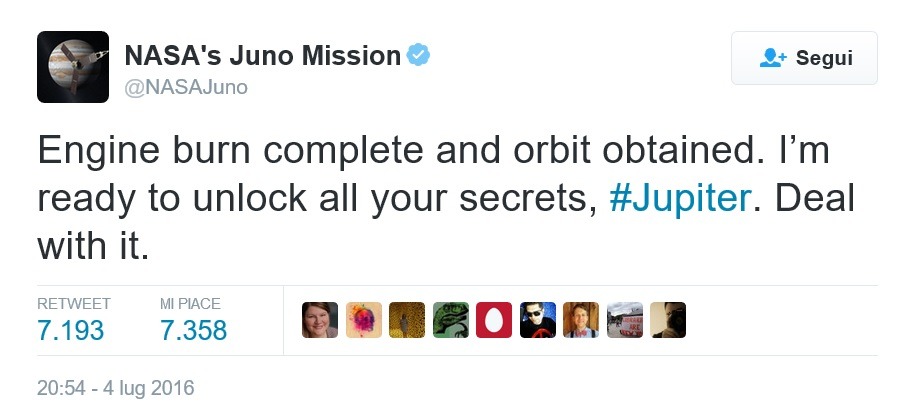
NASA’s Juno Spacecraft in Orbit Around Mighty Jupiter

After an almost five-year journey to the solar system’s largest
planet, NASA’s Juno spacecraft successfully entered Jupiter’s orbit
during a 35-minute engine burn. Confirmation that the burn had completed
was received on Earth at 8:53 p.m. PDT (11:53 p.m. EDT) Monday, July 4.

“Independence Day always is something to celebrate, but today we can
add to America’s birthday another reason to cheer – Juno is at
Jupiter,” said NASA administrator Charlie Bolden. “And what is more
American than a NASA mission going boldly where no spacecraft has gone
before? With Juno, we will investigate the unknowns of Jupiter’s massive
radiation belts to delve deep into not only the planet’s interior, but
into how Jupiter was born and how our entire solar system evolved.”

Confirmation of a successful orbit insertion was received from Juno
tracking data monitored at the navigation facility at NASA’s Jet
Propulsion Laboratory (JPL) in Pasadena, California, as well as at the
Lockheed Martin Juno operations center in Littleton, Colorado. The
telemetry and tracking data were received by NASA’s Deep Space Network
antennas in Goldstone, California, and Canberra, Australia.

“This is the one time I don’t mind being stuck in a windowless room
on the night of the 4th of July,” said Scott Bolton, principal
investigator of Juno from Southwest Research Institute in San Antonio.
“The mission team did great. The spacecraft did great. We are looking
great. It’s a great day.”

Preplanned events leading up to the orbital insertion engine burn
included changing the spacecraft’s attitude to point the main engine in
the desired direction and then increasing the spacecraft’s rotation rate
from 2 to 5 revolutions per minute (RPM) to help stabilize it..

The burn of Juno’s 645-Newton Leros-1b main engine began on time at
8:18 p.m. PDT (11:18 p.m. EDT), decreasing the spacecraft’s velocity by
1,212 miles per hour (542 meters per second) and allowing Juno to be
captured in orbit around Jupiter. Soon after the burn was completed,
Juno turned so that the sun’s rays could once again reach the 18,698
individual solar cells that give Juno its energy.

The spacecraft worked perfectly, which is always nice when you’re
driving a vehicle with 1.7 billion miles on the odometer
,” said Rick
Nybakken, Juno project manager from JPL. “Jupiter orbit insertion was a
big step and the most challenging remaining in our mission plan, but
there are others that have to occur before we can give the science team
the mission they are looking for.”

Over the next few months, Juno’s mission and science teams will
perform final testing on the spacecraft’s subsystems, final calibration
of science instruments and some science collection.

“Our official science collection phase begins in October, but we’ve
figured out a way to collect data a lot earlier than that,” said Bolton.
“Which when you’re talking about the single biggest planetary body in
the solar system is a really good thing. There is a lot to see and do
here.”

Juno’s principal goal is to understand the origin and evolution of
Jupiter. With its suite of nine science instruments, Juno will
investigate the existence of a solid planetary core, map Jupiter’s
intense magnetic field, measure the amount of water and ammonia in the
deep atmosphere, and observe the planet’s auroras
. The mission also will
let us take a giant step forward in our understanding of how giant
planets form and the role these titans played in putting together the
rest of the solar system. As our primary example of a giant planet,
Jupiter also can provide critical knowledge for understanding the
planetary systems being discovered around other stars.

The Juno spacecraft launched on Aug. 5, 2011 from Cape Canaveral Air
Force Station in Florida. JPL manages the Juno mission for NASA. Juno is
part of NASA’s New Frontiers Program, managed at NASA’s Marshall Space
Flight Center in Huntsville, Alabama, for the agency’s Science Mission
Directorate. Lockheed Martin Space Systems in Denver built the
spacecraft. The California Institute of Technology in Pasadena manages
JPL for NASA.

NASA’s Juno Spacecraft in Orbit Around Mighty Jupiter

1989

aliceindustland:

Ho smesso di uscire per sballarmi, per fare baldoria o anche solo per uscire e non stare in casa.
In casa sto bene, anche a non fare niente, sto bene anche solo a star seduta e pensare, mi invento le cose, quando dico che mi invento i mondi e poi faccio finta di viverci dico sul serio, quasi sempre c’è il mare e il sole.
Adesso in pratica io esco quasi solo per le sagre de paese, mi piace la pesca di beneficenza, la polenta e la trippa cucinata dalle signore del paese, i gruppi del paesello che cantano canzoni che conoscono tutti dai 35 anni in su e un sacco di gente improbabile che in nessun altro modo avrei incontrato.
Allora qualche sabato fa mia cugina mi chiama e mi chiede se avevo voglia di arrivare fin da loro per la festa de paese secondo me s’aspettava un secchissimo no con insulto annesso e invece io son stata felicissima e le ho detto cazzo sì, vengo.
L’ho presa larga, lo ammetto.
Come a tutte ste feste de paese anche lì c’era il bigliardino (come lo chiamate voi? calcio balilla?) e io ogni volta che ne vedo uno mi sciolgo in una pozza di nostalgia e felicità perchè, come ognuno di voi immagino, ci son cresciuta giocandoci.
Fnchè non sono arrivata in Italia non ne avevo mai toccato uno, nel senso che al bar “italiano” mio papà con gli amici ci giocava sempre, ma erano sempre tutti grandi e io ero oltretutto femmina e quindi per me era un territorio bandito, anzi nemmeno mi avvicinavo, proprio che lo vivevo timorosa.
Poi però quando arrivammo qui e i primi mesi andammo a vivere dai miei nonni paterni un ragazzetto figlio di vicini di casa storici ne aveva uno tutto suo, che glielo aveva regalato lo zio del brasile.
E allora il pomeriggi estivi noi andavamo a giocarci, quando i grandi dormivano o chissà che facevano, quei pomeriggi che ricordo mio padre ancora giovane e i miei zii coi pantaloncini che giocavano a calcio davanti al garage e bestemmiavano, quei pomeriggi lì, che l’unica cosa che non cambiava mai era che io son sempre stata l’unica femmina, noi andavamo lì e giocavamo con le stecche, che non le devi far rullare mai, che le devi tener ferme che devi dare il colpo secco e prenderla con gli angoli degli omini per crossarla e i piccoli stavano lì a prendersi le pallate in fronte e in faccia e poi toccava sempre a loro andarla a raccattare e attento alle dita e no che cazzo ha fatto gol, ma io davanti non so giocare allora  sto in difesa sì, ma se ti fanno gol non giochi più con me, dai facciamo cambio squadre io gioco sempre co le più pippe e via così fino all’età in cui ti giochi le birre e chi perde paga.
Ogni volta che vedo un cazzo di bigliardino, che ci stavamo giocando anche a villa ada quando i fasci ci hanno attaccato, io ogni volta che ne vedo uno mi ricordo quei pomeriggi in cui papà era ancora giovane e dopo di noi giocavano loro, papà e tutto il gruppo di fratelli e vicini venivano lì prima di cena e si sfidavano a bicchieri di vino e si insultavano in spagnolo, hijo de puta! E bestemmiavano e noi raccattavamo le palle che scappavano e ogni cazzo di partita lì in quel momento in quell’aria estiva in cui non sapevo davvero ancora niente, ogni cazzo di partita sembrava una finale dei mondiali.