Someone’s got to be first. In space, the first explorers beyond Mars were Pioneers 10 and 11, twin robots who charted the course to the cosmos.
1-Before Voyager
Voyager, with its outer solar system tour and interstellar observations, is often credited as the greatest robotic space mission. But today we remember the plucky Pioneers, the spacecraft that proved Voyager’s epic mission was possible.
2-Where No One Had Gone Before
Forty-five years ago this week, scientists still weren’t sure how hard it would be to navigate the main asteroid belt, a massive field of rocky debris between Mars and Jupiter. Pioneer 10 helped them work that out, emerging from first the first six-month crossing in February 1973. Pioneer 10 logged a few meteoroid hits (fewer than expected) and taught engineers new tricks for navigating farther and farther beyond Earth.
3-Trailblazer No. 2
Pioneer 11 was a backup spacecraft launched in 1973 after Pioneer 10 cleared the asteroid belt. The new mission provided a second close look at Jupiter, the first close-up views of Saturn and also gave Voyager engineers plotting an epic multi-planet tour of the outer planets a chance to practice the art of interplanetary navigation.
4-First to Jupiter
Three-hundred and sixty-three years after humankind first looked at Jupiter through a telescope, Pioneer 10 became the first human-made visitor to the Jovian system in December 1973. The spacecraft spacecraft snapped about 300 photos during a flyby that brought it within 81,000 miles (about 130,000 kilometers) of the giant planet’s cloud tops.
5-Pioneer Family
Pioneer began as a Moon program in the 1950s and evolved into increasingly more complicated spacecraft, including a Pioneer Venus mission that delivered a series of probes to explore deep into the mysterious toxic clouds of Venus. A family portrait (above) showing (from left to right) Pioneers 6-9, 10 and 11 and the Pioneer Venus Orbiter and Multiprobe series. Image date: March 11, 1982.
6-A Pioneer and a Pioneer
Classic rock has Van Halen, we have Van Allen. With credits from Explorer 1 to Pioneer 11, James Van Allen was a rock star in the emerging world of planetary exploration. Van Allen (1914-2006) is credited with the first scientific discovery in outer space and was a fixture in the Pioneer program. Van Allen was a key part of the team from the early attempts to explore the Moon (he’s pictured here with Pioneer 4) to the more evolved science platforms aboard Pioneers 10 and 11.
7-The Farthest…For a While
For more than 25 years, Pioneer 10 was the most distant human-made object, breaking records by crossing the asteroid belt, the orbit of Jupiter and eventually even the orbit of Pluto. Voyager 1, moving even faster, claimed the most distant title in February 1998 and still holds that crown.
8-Last Contact
We last heard from Pioneer 10 on Jan. 23, 2003. Engineers felt its power source was depleted and no further contact should be expected. We tried again in 2006, but had no luck. The last transmission from Pioneer 11 was received in September 1995. Both missions were planned to last about two years.
9-Galactic Ghost Ships
Pioneers 10 and 11 are two of five spacecraft with sufficient velocity to escape our solar system and travel into interstellar space. The other three—Voyagers 1 and 2 and New Horizons—are still actively talking to Earth. The twin Pioneers are now silent. Pioneer 10 is heading generally for the red star Aldebaran, which forms the eye of Taurus (The Bull). It will take Pioneer over 2 million years to reach it. Pioneer 11 is headed toward the constellation of Aquila (The Eagle) and will pass nearby in about 4 million years.
10-The Original Message to the Cosmos
Years before Voyager’s famed Golden Record, Pioneers 10 and 11 carried the original message from Earth to the cosmos. Like Voyager’s record, the Pioneer plaque was the brainchild of Carl Sagan who wanted any alien civilization who might encounter the craft to know who made it and how to contact them. The plaques give our location in the galaxy and depicts a man and woman drawn in relation to the spacecraft.
Read the full version of this week’s 10 Things article HERE.
Make sure to follow us on Tumblr for your regular dose of space: http://nasa.tumblr.com.
There are infinite worlds both like and unlike this world of ours. We must believe that in all worlds there are living creatures and plants and other things we see in this world. – Epicurus, c. 300 B.C.
Are we alone? Are there other planets like ours? Does life exist elsewhere in the universe?
These are questions mankind has been asking for years—since the time of Greek philosophers. But for years, those answers have been elusive, if not impossible to find.
The month of October marks the 21st anniversary of the discovery of the first planet orbiting another sun-like star (aka. an exoplanet), 51 Pegasi b or “Dimidium.” Its existence proved that there were other planets in the galaxy outside our solar system.*
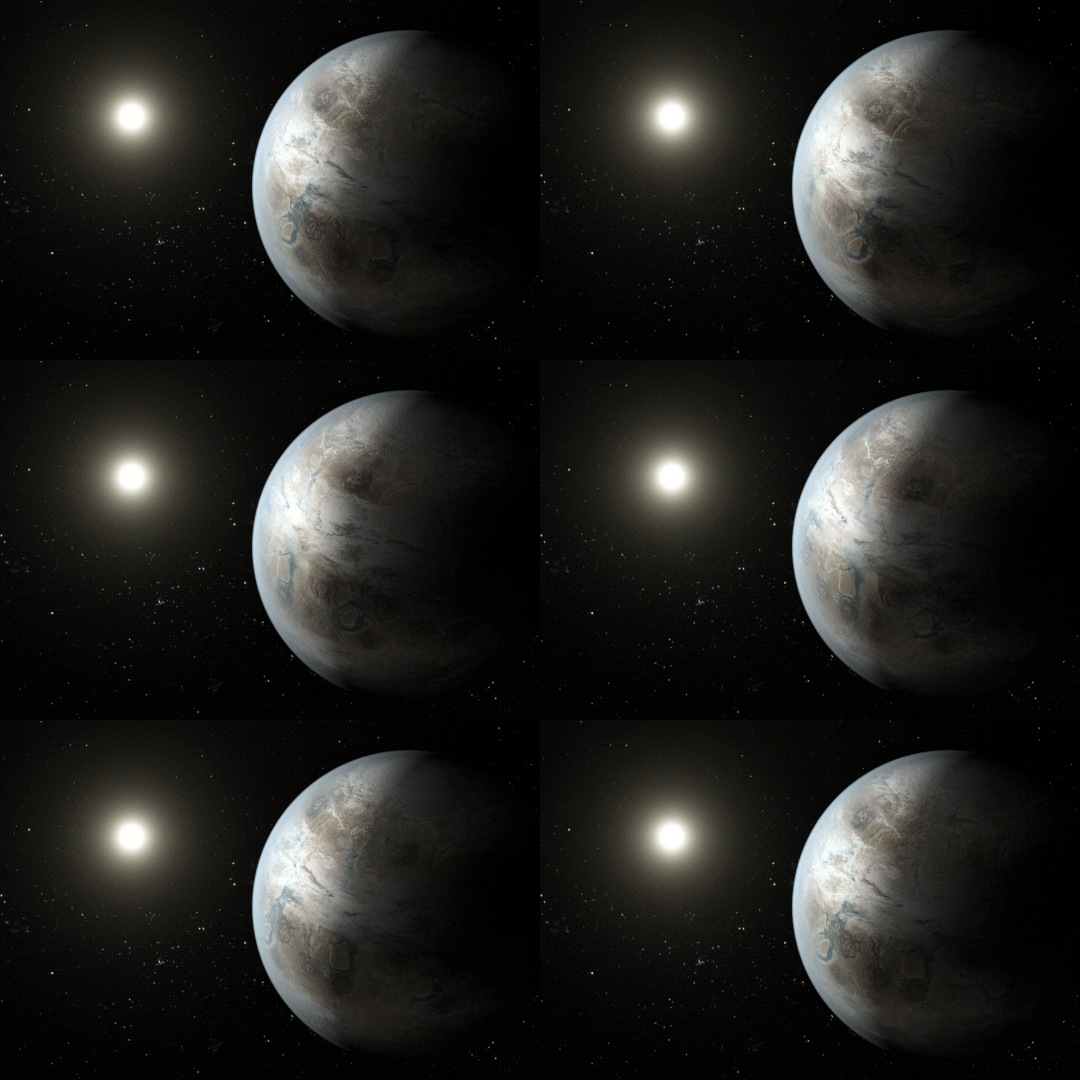
Even more exciting is the fact that astronomers are in hot pursuit of the first discovery of an Earth-like exoplanet orbiting a star other than the sun. The discovery of the so-called “blue dot” could redefine our understanding of the universe and our place in it, especially if astronomers can also find signs that life exists on that planet’s surface.
Astronomy is entering a fascinating era where we’re beginning to answer tantalizing questions that people have pondered for thousands of years.
Are we alone?
In 1584, when the Catholic monk Giordano Bruno asserted that there were “countless suns and countless earths all rotating around their suns,” he was accused of heresy.
But even in Bruno’s time, the idea of a plurality of worlds wasn’t entirely new. As far back as ancient Greece, humankind has speculated that other solar systems might exist and that some would harbor other forms of life.
Still, centuries passed without convincing proof of planets around even the nearest stars.
Are there other planets like ours?
The first discovery of a planet orbiting a star similar to the sun came in 1995. The Swiss team of Michel Mayor and Didier Queloz of Geneva announced that they had found a rapidly orbiting gas world located blisteringly close to the star 51 Pegasi.
This announcement marked the beginning of a flood of discoveries. Exotic discoveries transformed science fiction into science fact:
Our first exoplanet mission**, Kepler, launched in 2009 and revolutionized how astronomers understand the universe and our place in it. Kepler was built to answer the question—how many habitable planets exist in our galaxy?
And it delivered: Thousands of planet discoveries poured in, providing statistical proof that one in five sun-like stars (yellow, main-sequence G type) harbor Earth-sized planets orbiting in their habitable zones– where it’s possible liquid water could exist on their surface.
Now, our other missions like the Hubble and Spitzer space telescopes point at promising planetary systems (TRAPPIST-1) to figure out whether they are suitable for life as we know it.
Does life exist elsewhere in the universe?
Now that exoplanet-hunting is a mainstream part of astronomy, the race is on to build instruments that can find more and more planets, especially worlds that could be like our own.
Our Transiting Exoplanet Survey Satellite (TESS), set for launch in 2017-2018, will look for super-Earth and Earth-sized planets around stars much closer to home. TESS will find new planets the same way Kepler does—via the transit method—but will cover 400 times the sky area.
The James Webb Space Telescope, to launch in 2018, wil be our most powerful space telescope to date. Webb will use its spectrograph to look at exoplanet atmospheres, searching for signs of life.
We still don’t know where or which planets are in the habitable zones of the nearest stars to Earth. Searching out our nearest potentially habitable neighbors will be the next chapter in this unfolding story.
*The first true discovery of extrasolar planets was actually a triplet of dead worlds orbiting the remains of an exploded star, called a pulsar star. Two of three were found by Dr. Alexander Wolszczan in 1992– a full three years before Dimidium’s discovery. But because they are so strange, and can’t support life as we know it, most scientists would reserve the “first” designation for a planet orbiting a normal star.
** The French CoRoT mission, launched in 2006, was the first dedicated exoplanet space mission. It has contributed dozens of confirmed exoplanets to the ranks and boasts a roster of some of the most well-studied planets outside our solar system.




 GigiopixTumblr