Someone’s got to be first. In space, the first explorers beyond Mars were Pioneers 10 and 11, twin robots who charted the course to the cosmos.
1-Before Voyager
Voyager, with its outer solar system tour and interstellar observations, is often credited as the greatest robotic space mission. But today we remember the plucky Pioneers, the spacecraft that proved Voyager’s epic mission was possible.
2-Where No One Had Gone Before
Forty-five years ago this week, scientists still weren’t sure how hard it would be to navigate the main asteroid belt, a massive field of rocky debris between Mars and Jupiter. Pioneer 10 helped them work that out, emerging from first the first six-month crossing in February 1973. Pioneer 10 logged a few meteoroid hits (fewer than expected) and taught engineers new tricks for navigating farther and farther beyond Earth.
3-Trailblazer No. 2
Pioneer 11 was a backup spacecraft launched in 1973 after Pioneer 10 cleared the asteroid belt. The new mission provided a second close look at Jupiter, the first close-up views of Saturn and also gave Voyager engineers plotting an epic multi-planet tour of the outer planets a chance to practice the art of interplanetary navigation.
4-First to Jupiter
Three-hundred and sixty-three years after humankind first looked at Jupiter through a telescope, Pioneer 10 became the first human-made visitor to the Jovian system in December 1973. The spacecraft spacecraft snapped about 300 photos during a flyby that brought it within 81,000 miles (about 130,000 kilometers) of the giant planet’s cloud tops.
5-Pioneer Family
Pioneer began as a Moon program in the 1950s and evolved into increasingly more complicated spacecraft, including a Pioneer Venus mission that delivered a series of probes to explore deep into the mysterious toxic clouds of Venus. A family portrait (above) showing (from left to right) Pioneers 6-9, 10 and 11 and the Pioneer Venus Orbiter and Multiprobe series. Image date: March 11, 1982.
6-A Pioneer and a Pioneer
Classic rock has Van Halen, we have Van Allen. With credits from Explorer 1 to Pioneer 11, James Van Allen was a rock star in the emerging world of planetary exploration. Van Allen (1914-2006) is credited with the first scientific discovery in outer space and was a fixture in the Pioneer program. Van Allen was a key part of the team from the early attempts to explore the Moon (he’s pictured here with Pioneer 4) to the more evolved science platforms aboard Pioneers 10 and 11.
7-The Farthest…For a While
For more than 25 years, Pioneer 10 was the most distant human-made object, breaking records by crossing the asteroid belt, the orbit of Jupiter and eventually even the orbit of Pluto. Voyager 1, moving even faster, claimed the most distant title in February 1998 and still holds that crown.
8-Last Contact
We last heard from Pioneer 10 on Jan. 23, 2003. Engineers felt its power source was depleted and no further contact should be expected. We tried again in 2006, but had no luck. The last transmission from Pioneer 11 was received in September 1995. Both missions were planned to last about two years.
9-Galactic Ghost Ships
Pioneers 10 and 11 are two of five spacecraft with sufficient velocity to escape our solar system and travel into interstellar space. The other three—Voyagers 1 and 2 and New Horizons—are still actively talking to Earth. The twin Pioneers are now silent. Pioneer 10 is heading generally for the red star Aldebaran, which forms the eye of Taurus (The Bull). It will take Pioneer over 2 million years to reach it. Pioneer 11 is headed toward the constellation of Aquila (The Eagle) and will pass nearby in about 4 million years.
10-The Original Message to the Cosmos
Years before Voyager’s famed Golden Record, Pioneers 10 and 11 carried the original message from Earth to the cosmos. Like Voyager’s record, the Pioneer plaque was the brainchild of Carl Sagan who wanted any alien civilization who might encounter the craft to know who made it and how to contact them. The plaques give our location in the galaxy and depicts a man and woman drawn in relation to the spacecraft.
Read the full version of this week’s 10 Things article HERE.
Make sure to follow us on Tumblr for your regular dose of space: http://nasa.tumblr.com.
See history in the making on September 22! That’s the day OSIRIS-REx, the first U.S. mission to carry samples from an asteroid back to Earth, will make a close approach to Earth as it uses our planet’s gravity to slingshot itself toward the asteroid Bennu.
Over the course of several days, observatories and amateur astronomers will be able to spot the spacecraft. Below, 10 things to know about this incredible mission that will bring us the largest sample returned from space since the Apollo era.
1. Big Deal
OSIRIS-REx seeks answers to the questions that are central to the human experience: Where did we come from? What is our destiny? Asteroids, the leftover debris from the solar system formation process, can help us answer these questions and teach us about the history of the Sun and planets.
2. That’s a Long Acronym
Yup. OSIRIS-REx stands for the Origins, Spectral Interpretation, Resource Identification, Security-Regolith Explorer spacecraft. The gist: It will rendezvous with, study, and return a sample of the asteroid Bennu to Earth.
3. Lots of Instruments, Too
While all the acronyms for each instrument may be alphabet soup, each has a job/role to perform in order to complete the mission. Explore what each one will do in this interactive webpage.
4. Nice to Meet You, Bennu
Scientists chose Bennu as the mission target because of its composition, size, and proximity to Earth. Bennu is a rare B-type asteroid (primitive and carbon-rich), which is expected to have organic compounds and water-bearing minerals like clays.
5. Hard Knock Life
Bennu had a tough life in a rough neighborhood: the early solar system. It’s an asteroid the size of a small mountain born from the rubble of a violent collision, hurled through space for millions of years and dismembered by the gravity of planets—but that’s exactly what makes it a fascinating destination.
6. High Fives All Around
In 2018, OSIRIS-REx will approach Bennu and begin an intricate dance with the asteroid, mapping and studying Bennu in preparation for sample collection. In July 2020, the spacecraft will perform a daring maneuver in which its 11-foot arm will reach out for a five-second “high-five” to stir up surface material, collecting at least 2 ounces (60 grams) of small rocks and dust into a sample return capsule.
7. Home Sweet Home
OSIRIS-REx launched on September 8, 2016 from Cape Canaveral, Florida on an Atlas V rocket. In March 2021, the window for departure from the asteroid will open and OSIRIS-REx will begin its return journey to Earth, arriving two-and-a-half years later in September 2023.
8. Precious Cargo
The sample will head to Earth inside of a return capsule with a heat shield and parachutes that will separate from the spacecraft once it enters the Earth’s atmosphere. The capsule containing the sample will be collected at the Utah Test and Training Range. Once it arrives, it will be transported to NASA’s Johnson Space Center in Houston for examination. For two years after the sample return (from late 2023-2025) the science team will catalog the sample and conduct the analysis needed to meet the mission science goals. NASA will preserve at least 75% of the sample at NASA’s Johnson Space Flight Center in Houston for further research by scientists worldwide, including future generations of scientists.
9. Knowledge Is Power
Analyzing the sample will help scientists understand the early solar system, as well as the hazards and resources of near-Earth space. Asteroids are remnants of the building blocks that formed the planets and enabled life. Those like Bennu contain natural resources such as water, organics and metals. Future space exploration and economic development may rely on asteroids for these materials.
10. Hitch a Ride
Journey with OSIRIS-REx as it launches, cruises, and arrives to Bennu in this interactive timeline.
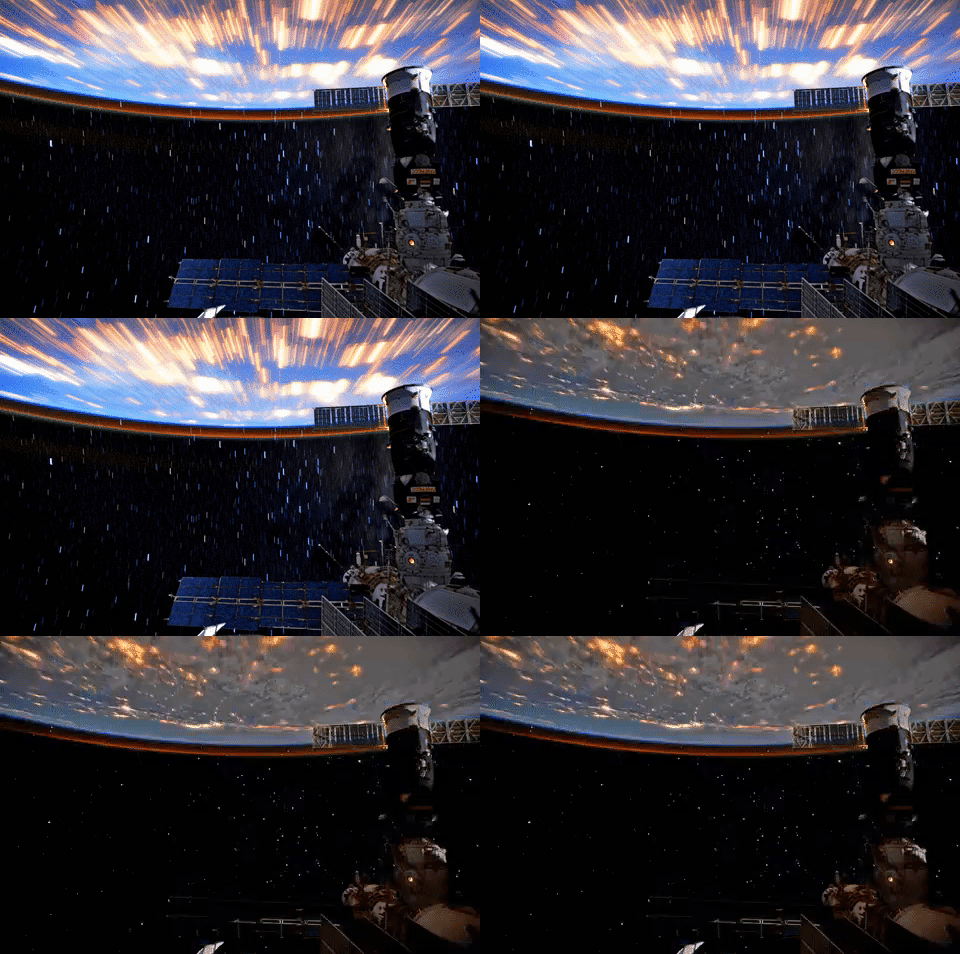
Freaky fast and really awesome! NASA astronaut Jack Fischer posted this GIF to his social media Tuesday saying, “I was checking the view out the back window & decided to take a pic so you can see proof of our ludicrous speed! #SpaceIsAwesome”.
In case you didn’t know, the International Space Station travels 17,500 miles per hour as it orbits 250 miles above the Earth.
Currently, three humans are living and working there, conducting important science and research. The orbiting laboratory is home to more than 250 experiments, including some that are helping us determine the effects of microgravity on the human body. Research on the station will not only help us send humans deeper into space than ever before, including to Mars, but also benefits life here on Earth.
We’re incredibly lucky to live on a planet
drenched in water, nestled in a perfect distance from our sun and wrapped with
magnetic fields keeping our atmosphere intact against harsh radiation and space
weather.
We know from recent research that life can
persist in the cruelest of environments here on Earth, which gives us hope to
finding life thriving on other worlds. While we have yet to find life outside
of Earth, we are optimistic about the possibilities, especially on other ocean
worlds right here in our solar system.
So…What’s the News?!
Two of our veteran missions are providing
tantalizing new details about icy, ocean-bearing moons of Jupiter and Saturn,
further enhancing the scientific interest of these and other “ocean worlds” in
our solar system and beyond!
Cassini
scientists announce that a form of energy for life appears to exist in Saturn’s
moon Enceladus, and Hubble
researchers report additional evidence of plumes erupting from Jupiter’s moon
Europa.
The Two Missions: Cassini and Hubble
Cassini
Our Cassini
spacecraft has found that hydrothermal vents in the ocean of Saturn’s icy moon Enceladus
are producing hydrogen gas, which could potentially provide a chemical energy
source for life.
Cassini discovered that this little moon of
Saturn was active in 2005. The discovery that Enceladus has jets of gas and icy
particles coming out of its south polar region surprised the world. Later we
determined that plumes of material are coming from a global ocean under the icy
crust, through large cracks known as “tiger stripes.”
We have more evidence now – this time sampled
straight from the plume itself – of hydrothermal activity, and we now know the
water is chemically interacting with the rock beneath the ocean and producing
the kind of chemistry that could be used by microbes IF they happened to be
there.
This is the culmination of 12 years of
investigations by Cassini and a capstone finding for the mission. We now know Enceladus
has nearly all the ingredients needed for life as we know it.
The Cassini spacecraft made its deepest dive
through the plume on Oct. 28, 2015. From previous flybys, Cassini determined
that nearly 98% of the gas in the plume is water and the rest is a mixture of
other molecules, including carbon dioxide, methane and ammonia.
Cassini’s other
instruments provided evidence of hydrothermal activity in the ocean. What we
really wanted to know was…Is there hydrogen being produced that microbes could
use to make energy? And that’s exactly what we found!
To be clear…we haven’t discovered microbes at
Enceladus, but vents of this type at Earth host these kinds of life. We’re
cautiously excited at the prospect that there might be something like this at
Enceladus too!
Hubble
The Hubble Space
Telescope has also been studying another ocean world in our solar system:
Europa!
Europa is one of the four major moons of
Jupiter, about the size of our own moon but very different in appearance. It’s
a cold, icy world with a relatively smooth, bright surface crisscrossed with
dark cracks and patches of reddish material.
What makes Europa interesting is that it’s believed
to have a global ocean, underneath a thick crust of ice. In fact, it’s got
about twice as much ocean as planet Earth!
In 2014, we detected evidence of intermittent
water plumes on the surface of Europa, which is interesting because they may
provide us with easier access to subsurface liquid water without having to
drill through miles of ice.
And now, in 2016, we’ve found one particular
plume candidate that appears to be at the same location that it
was seen in 2014.
This is exciting because if we can establish that a
particular feature does repeat, then it is much more likely to be real and we
can attempt to study and understand the processes that cause it to turn on or
off.
This plume also happens to coincide with an
area where Europa is unusually warm as compared to the surrounding terrain. The
plume candidates are about 30 to 60 miles (50 to 100 kilometers) in height and are well-positioned for
observation, being in a relatively equatorial and well-determined location.
What Does All This Mean and What’s Next?
Hubble and Cassini are inherently different
missions, but their complementary scientific discoveries, along with the synergy
between our current and planned missions, will help us in finding out whether
we are alone in the universe.
Hubble will continue to observe Europa. If
you’re wondering how we might be able to get more information on the Europa
plume, the upcoming Europa Clipper mission
will be carrying
a suite of 9 instruments to investigate whether the mysterious icy moon could harbor conditions favorable for life. Europa Clipper is slated to launch in the 2020s.
This future mission will be able to study the
surface of Europa in great detail and assess the habitability of this moon.
Whether there’s life there or not is a question for this future mission to
discover!




 GigiopixTumblr