

the future is beautiful
don’t panic
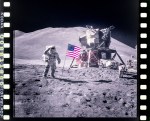
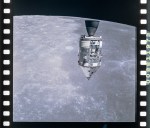
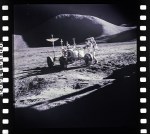
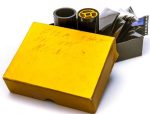


I recently had the amazing opportunity to work with some very interesting historical media. A retired NASA engineer friend contacted me having found a box of photographic films in his desk drawer. Turns out the box contained two partial rolls and several cut slides of 70mm film from the 1971 Apollo 15 mission! What a find!
According to my engineer friend, these are not unpublished images. They are, however original films from the customized Hasselblad EDC (Electronic Data Cameras) medium format cameras used on the lunar surface, and include numerous images of the astronauts, the Lunar Module — the “Falcon” (LM-10), and Lunar Rover (LRV). There are also multiple images from orbit featuring the Command Module – Endeavor (CM-112). As a photographer, I found it interesting
that there is one image showing the camera mounted on a bracket on the chest of the astronaut’s space suit. The cameras were essentially point and shoot – whichever direction the astronaut was pointed, it shot.Apollo 15 Scans-JCHP-0006The actual composition of the film remains something of a mystery, but was reportedly a custom Ektachrome formulation that Kodak developed for the NASA missions. The 70mm sprocketed film was thinner than typical film – allowing for more frames per roll. (Imagine trying to change film in a space suit). The team took multiple cameras to the moon, but brought back only the expended film magazines. The actual camera bodies were left behind to conserve weight on the return voyage.
There were a few challenges in photographing the film. The film was in pretty good shape for having been stored in a box in a desk drawer for 40+ years. It has a heavy blue-ish color cast. I’m not certain if that’s a function of age, or something unique to the particular film stock. So it required some significant color correction in post.
Film Digitizing Setup-JCHP-6373I digitized the film with a Nikon D810 DSLR / 105 macro lens combo and an LED light panel. I considered scanning, but the scanner’s 60mm medium format negative carrier would not accommodate the slightly wider 70mm film. However, with a little trial and error, and the help of my son’s 3D printer, I was able to create a film holder to fit the NASA film that enabled me to capture the entire width / frame numbers, film stock info, etc. This worked great for most of the film, but was not usable with the cut frames since there was no glass to keep them flat. For those remaining images, I purchased a piece of anti-newton glass, and was able to sandwich them between the glass and the LED panel.
How these treasures ended up in my friend’s desk drawer at NASA may never be determined. But the fact that they’ve been to the moon and back makes this film just about the coolest thing I’ve ever had my hands on
It looks like Republican and Democratic senators alike are keen on safeguarding America’s space programs. With the potential chaos of a new president on the horizon, the Senate Committee on Commerce, Science, and Transportation passed a bipartisan bill giving NASA $19.5 billion to continue working on a mission to Mars. It also includes support for the continuation of the program to send astronauts on private rockets to the International Space Station (ISS) from American soil no later than 2018.
“We have seen in the past the importance of stability and predictability in NASA and space exploration – that whenever one has a change in administration, we have seen the chaos that can be caused by the cancellation of major programs,” Republican Senator Ted Cruz, lead sponsor of the bill, commented. “The impact in terms of jobs lost, the impact in terms of money wasted has been significant.”
The NASA Transition Authorization Act of 2016 includes an overall authorization level of $19.508 billion for fiscal year 2017, but it still needs to be passed by the Senate as a whole, of course. The budget allotted is the same as what was approved by House appropriators and a bit more than the version released by the Senate Appropriations Committee. The Obama administration, likewise, proposed $19 billion in funding for NASA.

The Senate is not giving NASA money just for the sake of exploration. It is also a challenge, a mandate, actually. The bill requires that NASA make it an official goal to send crewed missions to Mars in the next 25 years.
The bill allocates funds for different components: $4.5 billion on exploration, nearly $5 billion for space operations, and $5.4 billion for science. It also does not scrap NASA’s controversial plans to send men on asteroids and collect samples by 2021. It does, however, require the space agency to regularly send progress reports to Congress, justifying its $1.4 billion cost.
“Fifty-five years after President Kennedy challenged the nation to put a man on the moon, the Senate is challenging NASA to put humans on Mars. The priorities that we’ve laid out for NASA in this bill mark the beginning of a new era of American spaceflight,” said an optimistic Florida Sen. Bill Nelson, senior Democrat on the Commerce panel.
The bipartisan support behind the new bill shows that space exploration is an issue that all parties can agree is vital to our growth as a nation and a species. Now we just have to wait to see if it passes the Senate.
19,5 MILIARDI DI DOLLARI.
Il più grande budget
di sempre
stanziato per la NASA, (e il secondo dopo quello del 1965, se teniamo conto dell’inflazione).
La corsa verso Marte comincia a farsi molto concreta.
 GigiopixTumblr