

Il metodo scientifico di @tsuki-nh, quando mi deve inviare 40 foto.
Il metodo scientifico di @tsuki-nh, quando mi deve inviare 40 foto.
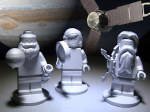


Ma quanto saranno nerd alla NASA ? Spari una sonda su un nuovo pianeta, per un viaggio nello spazio di 5 anni e 3 miliardi di km, e ci metti sopra tre figurine LEGO, lol 😀
After an almost five-year journey to the solar system’s largest
planet, NASA’s Juno spacecraft successfully entered Jupiter’s orbit
during a 35-minute engine burn. Confirmation that the burn had completed
was received on Earth at 8:53 p.m. PDT (11:53 p.m. EDT) Monday, July 4.
“Independence Day always is something to celebrate, but today we can
add to America’s birthday another reason to cheer – Juno is at
Jupiter,” said NASA administrator Charlie Bolden. “And what is more
American than a NASA mission going boldly where no spacecraft has gone
before? With Juno, we will investigate the unknowns of Jupiter’s massive
radiation belts to delve deep into not only the planet’s interior, but
into how Jupiter was born and how our entire solar system evolved.”
Confirmation of a successful orbit insertion was received from Juno
tracking data monitored at the navigation facility at NASA’s Jet
Propulsion Laboratory (JPL) in Pasadena, California, as well as at the
Lockheed Martin Juno operations center in Littleton, Colorado. The
telemetry and tracking data were received by NASA’s Deep Space Network
antennas in Goldstone, California, and Canberra, Australia.
“This is the one time I don’t mind being stuck in a windowless room
on the night of the 4th of July,” said Scott Bolton, principal
investigator of Juno from Southwest Research Institute in San Antonio.
“The mission team did great. The spacecraft did great. We are looking
great. It’s a great day.”
Preplanned events leading up to the orbital insertion engine burn
included changing the spacecraft’s attitude to point the main engine in
the desired direction and then increasing the spacecraft’s rotation rate
from 2 to 5 revolutions per minute (RPM) to help stabilize it..
The burn of Juno’s 645-Newton Leros-1b main engine began on time at
8:18 p.m. PDT (11:18 p.m. EDT), decreasing the spacecraft’s velocity by
1,212 miles per hour (542 meters per second) and allowing Juno to be
captured in orbit around Jupiter. Soon after the burn was completed,
Juno turned so that the sun’s rays could once again reach the 18,698
individual solar cells that give Juno its energy.
“The spacecraft worked perfectly, which is always nice when you’re
driving a vehicle with 1.7 billion miles on the odometer,” said Rick
Nybakken, Juno project manager from JPL. “Jupiter orbit insertion was a
big step and the most challenging remaining in our mission plan, but
there are others that have to occur before we can give the science team
the mission they are looking for.”
Over the next few months, Juno’s mission and science teams will
perform final testing on the spacecraft’s subsystems, final calibration
of science instruments and some science collection.
“Our official science collection phase begins in October, but we’ve
figured out a way to collect data a lot earlier than that,” said Bolton.
“Which when you’re talking about the single biggest planetary body in
the solar system is a really good thing. There is a lot to see and do
here.”
Juno’s principal goal is to understand the origin and evolution of
Jupiter. With its suite of nine science instruments, Juno will
investigate the existence of a solid planetary core, map Jupiter’s
intense magnetic field, measure the amount of water and ammonia in the
deep atmosphere, and observe the planet’s auroras. The mission also will
let us take a giant step forward in our understanding of how giant
planets form and the role these titans played in putting together the
rest of the solar system. As our primary example of a giant planet,
Jupiter also can provide critical knowledge for understanding the
planetary systems being discovered around other stars.
The Juno spacecraft launched on Aug. 5, 2011 from Cape Canaveral Air
Force Station in Florida. JPL manages the Juno mission for NASA. Juno is
part of NASA’s New Frontiers Program, managed at NASA’s Marshall Space
Flight Center in Huntsville, Alabama, for the agency’s Science Mission
Directorate. Lockheed Martin Space Systems in Denver built the
spacecraft. The California Institute of Technology in Pasadena manages
JPL for NASA.
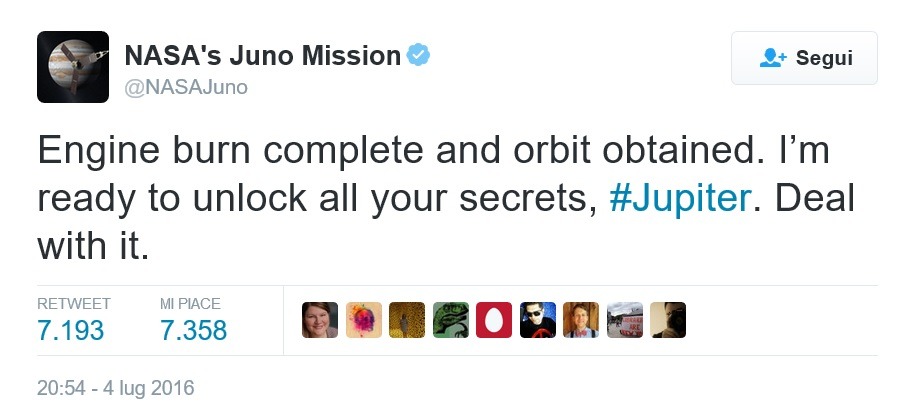

Inserimento in orbita completato con successo ! Juno ce l’ha fatta ! Abbiamo una sonda su Giove !
5 anni di volo, 3 miliardi di km percorsi, e nemmeno una virgola fuori dal previsto. Qua la diretta NASA

 GigiopixTumblr