Continuo a veder girare fini ragionamenti intellettuali sul fatto che quella ragazza di Catania sia morta perché il ginecologo era obiettore di coscienza, quindi volevo scusarmi con tutte queste persone se precedentemente avevo usato il termine ‘sbraitare’ riferito al loro.
Non state sbraitando, state frignando.
Blaterando, generalizzando, puntualizzando pretestuosamente, svarionando, rigurgitando frustrazioni, confondendovi, evitando il punto, vanificandovi e vanificando la presa di coscienza su una realtà che in certe regioni è davvero a metà strada tra Kafka e Kiewslowski.
Avrete sempre il mio appoggio quando si tratta di riflettere su cosa si trovano ad affrontare le donne quando devono fare una scelta così dolorosa senza un adeguato supporto delle istituzioni ma al primo accenno di PRETI ALLA VANGA! e di farneticazioni pretestuose senza il minimo vaglio o ragionamento perché scritte con l’ombelico (o con qualcosa più in basso) allora sappiate che vi piscerò volentieri in testa, senza neppure dirvi che sta piovendo.
There are infinite worlds both like and unlike this world of ours. We must believe that in all worlds there are living creatures and plants and other things we see in this world. – Epicurus, c. 300 B.C.
Are we alone? Are there other planets like ours? Does life exist elsewhere in the universe?
These are questions mankind has been asking for years—since the time of Greek philosophers. But for years, those answers have been elusive, if not impossible to find.
The month of October marks the 21st anniversary of the discovery of the first planet orbiting another sun-like star (aka. an exoplanet), 51 Pegasi b or “Dimidium.” Its existence proved that there were other planets in the galaxy outside our solar system.*
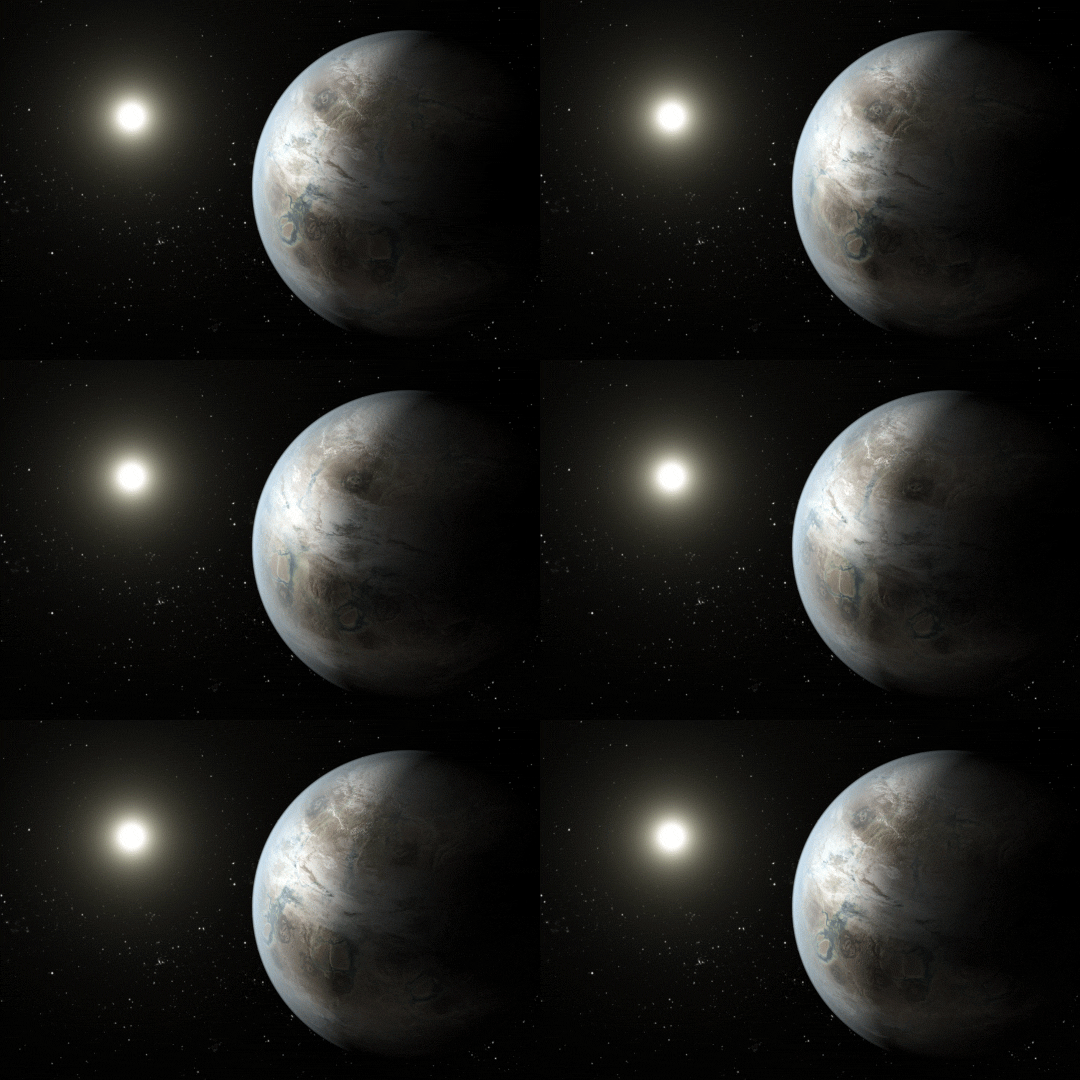
Even more exciting is the fact that astronomers are in hot pursuit of the first discovery of an Earth-like exoplanet orbiting a star other than the sun. The discovery of the so-called “blue dot” could redefine our understanding of the universe and our place in it, especially if astronomers can also find signs that life exists on that planet’s surface.
Astronomy is entering a fascinating era where we’re beginning to answer tantalizing questions that people have pondered for thousands of years.
Are we alone?
In 1584, when the Catholic monk Giordano Bruno asserted that there were “countless suns and countless earths all rotating around their suns,” he was accused of heresy.
But even in Bruno’s time, the idea of a plurality of worlds wasn’t entirely new. As far back as ancient Greece, humankind has speculated that other solar systems might exist and that some would harbor other forms of life.
Still, centuries passed without convincing proof of planets around even the nearest stars.
Are there other planets like ours?
The first discovery of a planet orbiting a star similar to the sun came in 1995. The Swiss team of Michel Mayor and Didier Queloz of Geneva announced that they had found a rapidly orbiting gas world located blisteringly close to the star 51 Pegasi.
This announcement marked the beginning of a flood of discoveries. Exotic discoveries transformed science fiction into science fact:
Our first exoplanet mission**, Kepler, launched in 2009 and revolutionized how astronomers understand the universe and our place in it. Kepler was built to answer the question—how many habitable planets exist in our galaxy?
And it delivered: Thousands of planet discoveries poured in, providing statistical proof that one in five sun-like stars (yellow, main-sequence G type) harbor Earth-sized planets orbiting in their habitable zones– where it’s possible liquid water could exist on their surface.
Now, our other missions like the Hubble and Spitzer space telescopes point at promising planetary systems (TRAPPIST-1) to figure out whether they are suitable for life as we know it.
Does life exist elsewhere in the universe?
Now that exoplanet-hunting is a mainstream part of astronomy, the race is on to build instruments that can find more and more planets, especially worlds that could be like our own.
Our Transiting Exoplanet Survey Satellite (TESS), set for launch in 2017-2018, will look for super-Earth and Earth-sized planets around stars much closer to home. TESS will find new planets the same way Kepler does—via the transit method—but will cover 400 times the sky area.
The James Webb Space Telescope, to launch in 2018, wil be our most powerful space telescope to date. Webb will use its spectrograph to look at exoplanet atmospheres, searching for signs of life.
We still don’t know where or which planets are in the habitable zones of the nearest stars to Earth. Searching out our nearest potentially habitable neighbors will be the next chapter in this unfolding story.
*The first true discovery of extrasolar planets was actually a triplet of dead worlds orbiting the remains of an exploded star, called a pulsar star. Two of three were found by Dr. Alexander Wolszczan in 1992– a full three years before Dimidium’s discovery. But because they are so strange, and can’t support life as we know it, most scientists would reserve the “first” designation for a planet orbiting a normal star.
** The French CoRoT mission, launched in 2006, was the first dedicated exoplanet space mission. It has contributed dozens of confirmed exoplanets to the ranks and boasts a roster of some of the most well-studied planets outside our solar system.
Ho terminato un progetto universitario. Si, alla mia età ancora con progetti universitari. Ma sono un recidivo. Dicevo, l’ho terminato e l’ho mandato. La cosa bella di studiare ingegneria è questa:
1) ti assegnano un progetto
2) leggi le specifiche e pensi “beh, tosto, ma fattibile”
3) inizi a lavorarci e scopri man mano che la parola migliore non è fattibile, ma IMPOSSIBILE
4) continui a lavorarci e scopri che, semmai ci fosse una minima possibilità terrena di poter completare questo progetto, SICURAMENTE richiederebbe un tempo t esponenzialmente più grande del tempo T che hai a disposizione
5) in preda allo sconforto ti poni davanti al bivio: accettare i limiti dell’essere umano, e trovare una soluzione facile o addirittura mollare il progetto (peraltro facoltativo, porcoddio); oppure ignorare completamente la logica e lo spirito di autoconservazione ed insistere, annullando le ore di cibo, di sonno, di iterazione sociale, di tutto, nel tentativo di fare qualcosa che sai che non potrà essere fatta
6) finisci il progetto. Lo osservi. Non sei completamente convinto di averlo fatto tu, non sei completamente convinto di averlo fatto davvero in tempo. Ma capisci una cosa: lo scopo della scienza è permetterti di realizzare le cose impossibili. Perché quelle possibili non vengono mai assegnate sotto forma di specifiche di progetto. Eccheccazzo.
Questo sito utilizza i cookie, te lo diciamo solo per romperti i coglioni, tanto l’alternativa è disdire internet o tornare al ’93.
NASA’s Voyager 2 spacecraft flew by Uranus 30 years ago, but researchers are still making discoveries from the data it gathered then. A new study led by University of Idaho researchers suggests there could be two tiny, previously undiscovered moonlets orbiting near two of the planet’s rings.
Rob Chancia, a University of Idaho doctoral student, spotted key patterns in the rings while examining decades-old images of Uranus’ icy rings taken by Voyager 2 in 1986. He noticed the amount of ring material on the edge of the alpha ring – one of the brightest of Uranus’ multiple rings – varied periodically. A similar, even more promising pattern occurred in the same part of the neighboring beta ring.
“When you look at this pattern in different places around the ring, the wavelength is different – that points to something changing as you go around the ring. There’s something breaking the symmetry,” said Matt Hedman, an assistant professor of physics at the University of Idaho, who worked with Chancia to investigate the finding. Their results will be published in The Astronomical Journal and have been posted to the pre-press site arXiv.
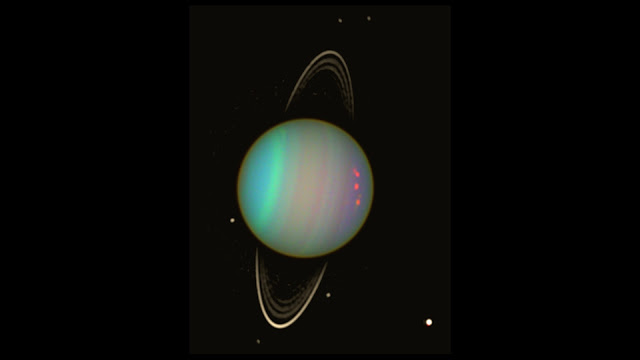
Image above: Uranus is seen in this false-color view from NASA’s Hubble Space Telescope from August 2003. The brightness of the planet’s faint rings and dark moons has been enhanced for visibility. Image Credits: NASA/Erich Karkoschka (Univ. Arizona).
Chancia and Hedman are well-versed in the physics of planetary rings: both study Saturn’s rings using data from NASA’s Cassini spacecraft, which is currently orbiting Saturn. Data from Cassini have yielded new ideas about how rings behave, and a grant from NASA allowed Chancia and Hedman to examine Uranus data gathered by Voyager 2 in a new light. Specifically, they analyzed radio occultations – made when Voyager 2 sent radio waves through the rings to be detected back on Earth – and stellar occultations, made when the spacecraft measured the light of background stars shining through the rings, which helps reveal how much material they contain.
They found the pattern in Uranus’ rings was similar to moon-related structures in Saturn’s rings called moonlet wakes.
The researchers estimate the hypothesized moonlets in Uranus’ rings would be 2 to 9 miles (4 to 14 kilometers) in diameter – as small as some identified moons of Saturn, but smaller than any of Uranus’ known moons. Uranian moons are especially hard to spot because their surfaces are covered in dark material.
“We haven’t seen the moons yet, but the idea is the size of the moons needed to make these features is quite small, and they could have easily been missed,” Hedman said. “The Voyager images weren’t sensitive enough to easily see these moons.”
Hedman said their findings could help explain some characteristics of Uranus’ rings, which are strangely narrow compared to Saturn’s. The moonlets, if they exist, may be acting as “shepherd” moons, helping to keep the rings from spreading out. Two of Uranus’ 27 known moons, Ophelia and Cordelia, act as shepherds to Uranus’ epsilon ring.
“The problem of keeping rings narrow has been around since the discovery of the Uranian ring system in 1977 and has been worked on by many dynamicists over the years,” Chancia said. “I would be very pleased if these proposed moonlets turn out to be real and we can use them to approach a solution.”
NASA’s Voyager 2 spacecraft Uranus flyby. Image Credit: NASA
Confirming whether or not the moonlets actually exist using telescope or spacecraft images will be left to other researchers, Chancia and Hedman said. They will continue examining patterns and structures in Uranus’ rings, helping uncover more of the planet’s many secrets.
“It’s exciting to see Voyager 2’s historic Uranus exploration still contributing new knowledge about the planets,” said Ed Stone, project scientist for Voyager, based at Caltech, Pasadena, California.
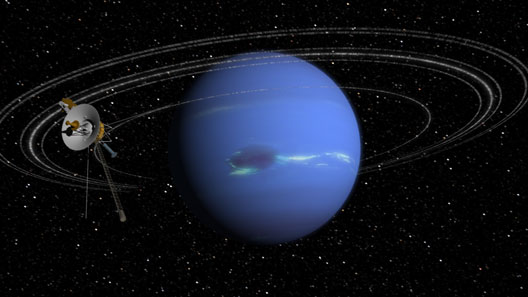
Voyager 2 and its twin, Voyager 1, were launched 16 days apart in 1977. Both spacecraft flew by Jupiter and Saturn, and Voyager 2 also flew by Uranus and Neptune. Voyager 2 is the longest continuously operated spacecraft. It is expected to enter interstellar space in a few years, joining Voyager 1, which crossed over in 2012. Though far past the planets, the mission continues to send back unprecedented observations of the space environment in the solar system, providing crucial information on the environment our spacecraft travel through as we explore farther and farther from home.
NASA’s Jet Propulsion Laboratory, a division of Caltech in Pasadena, California, built the twin Voyager spacecraft and operates them for the Heliophysics Division within NASA’s Science Mission Directorate in Washington.














 GigiopixTumblr