Il magma fuso potrebbe essere una fonte di energia sostenibile del futuro. Lo sta sperimentando un nuovo progetto in Islanda, che prevede una perforazione di 5 km di una zona a sud-ovest dell’Islanda, dove si potrebbe trovare materiale a temperature comprese tra 400 e 1.000 gradi Celsius.
Secondo gli esperti il vapore generato da questo foro potrebbe generare fino a 50 megawatt di energia elettrica, ossia 10 volte più efficiente dei tradizionali pozzi geotermici. Forse non molti ne sono informati, ma da decenni in molte aree del mondo si sfrutta l’energia geotermica, che prevede lo sfruttamento del calore naturale celato all’interno della crosta terrestre per alimentare turbine e generare elettricità.
L’Islanda è uno di questi siti, in virtù delle numerose sorgenti termali geologicamente attive: più di un quarto del paese è alimentato da pozzi a energia geotermica, che sfruttano il calore presente negli strati più profondi della crosta terrestre per generare corrente.
L’efficienza dell’energia geotermica tuttavia ha dei limiti, legati per lo più alle profondità che bisogna raggiungere. È qui che entra in gioco il nuovo progetto Iceland Deep Drilling Project (IDDP), che mira ad accedere direttamente a una fonte di calore quale il magma, che abbonda nei vulcani.
Oltre tutto, come capita spesso nella Scienza, questa idea è frutto di un errore: nel 2009 IDDP stava scavando per costruire un nuovo pozzo geotermico quando perforò accidentalmente un serbatoio di magma situato a circa 2 km sotto alla superficie. Gli scienziati versarono acqua nel buco per cercare di capire quanta energia si sarebbe potuta sprigionare, e dedussero che erano di fronte al più potente pozzo geotermico mai costruito, capace di produrre circa 30 megawatt di potenza.
Il progetto aveva solo titolo sperimentale, ma il gruppo di studiosi ha deciso di raccogliere la sfida e la nuova perforazione è iniziata il 12 agosto nella regione Reykjanes, che è fra le più geologicamente attive dell’Islanda. I ricercatori sperano di raggiungere ladorsale medio-atlantica, dove il magma riscalda l’acqua di mare ad alte temperature.
Albert Albertsson dell’azienda geotermica islandese HS Orka ha spiegato che una perforazione di rocce altrettanto dure non è inedita, ma non si era mai raggiunto un sistema fluido come questo, dove non solo l’acqua è molto calda, ma è anche sottoposta a una forte pressione. Per questo gli scienziati si aspettano che il pozzo generi “fluido supercritico” – uno stato della materia che non è né liquido, né gassoso – che dovrebbe offrire più energia termica di entrambi. In particolare, si parla di una capacità energetica fino a 50 megawatt, contro i 5 megawatt di un tipico pozzo geotermico. Conclusione: si potrebbero alimentare 50.000 abitazioni invece che 5.000.
È doveroso precisare che i dati per ora sono puramente teorici, e lo resteranno fino a quando il nuovo pozzo non sarà ultimato e funzionante. La perforazione dovrebbe essere terminata per fine anno, quindi bisognerà attendere i primi mesi del 2017 per valutare quanta energia elettrica sarà in grado di generare.
Se l’esperimento funzionerà sarà un importante precedente per le altre regioni del mondo che hanno vulcani nel sottosuolo.
No ma io voglio conoscere quei tizi che, dopo aver fatto un buo per terra profondo 2 km, e aver trovato per sbaglio il magma, HANNO PENSATO BENE DI TIRARCI DENTRO DELL’ACQUA. Mi pare di vederli. “Ma sarà come tirare una secchiata su una pentola di cera fusa? Farà
Continuo a veder girare fini ragionamenti intellettuali sul fatto che quella ragazza di Catania sia morta perché il ginecologo era obiettore di coscienza, quindi volevo scusarmi con tutte queste persone se precedentemente avevo usato il termine ‘sbraitare’ riferito al loro.
Non state sbraitando, state frignando.
Blaterando, generalizzando, puntualizzando pretestuosamente, svarionando, rigurgitando frustrazioni, confondendovi, evitando il punto, vanificandovi e vanificando la presa di coscienza su una realtà che in certe regioni è davvero a metà strada tra Kafka e Kiewslowski.
Avrete sempre il mio appoggio quando si tratta di riflettere su cosa si trovano ad affrontare le donne quando devono fare una scelta così dolorosa senza un adeguato supporto delle istituzioni ma al primo accenno di PRETI ALLA VANGA! e di farneticazioni pretestuose senza il minimo vaglio o ragionamento perché scritte con l’ombelico (o con qualcosa più in basso) allora sappiate che vi piscerò volentieri in testa, senza neppure dirvi che sta piovendo.
There are infinite worlds both like and unlike this world of ours. We must believe that in all worlds there are living creatures and plants and other things we see in this world. – Epicurus, c. 300 B.C.
Are we alone? Are there other planets like ours? Does life exist elsewhere in the universe?
These are questions mankind has been asking for years—since the time of Greek philosophers. But for years, those answers have been elusive, if not impossible to find.
The month of October marks the 21st anniversary of the discovery of the first planet orbiting another sun-like star (aka. an exoplanet), 51 Pegasi b or “Dimidium.” Its existence proved that there were other planets in the galaxy outside our solar system.*
Even more exciting is the fact that astronomers are in hot pursuit of the first discovery of an Earth-like exoplanet orbiting a star other than the sun. The discovery of the so-called “blue dot” could redefine our understanding of the universe and our place in it, especially if astronomers can also find signs that life exists on that planet’s surface.
Astronomy is entering a fascinating era where we’re beginning to answer tantalizing questions that people have pondered for thousands of years.
Are we alone?
In 1584, when the Catholic monk Giordano Bruno asserted that there were “countless suns and countless earths all rotating around their suns,” he was accused of heresy.
But even in Bruno’s time, the idea of a plurality of worlds wasn’t entirely new. As far back as ancient Greece, humankind has speculated that other solar systems might exist and that some would harbor other forms of life.
Still, centuries passed without convincing proof of planets around even the nearest stars.
Are there other planets like ours?
The first discovery of a planet orbiting a star similar to the sun came in 1995. The Swiss team of Michel Mayor and Didier Queloz of Geneva announced that they had found a rapidly orbiting gas world located blisteringly close to the star 51 Pegasi.
This announcement marked the beginning of a flood of discoveries. Exotic discoveries transformed science fiction into science fact:
Our first exoplanet mission**, Kepler, launched in 2009 and revolutionized how astronomers understand the universe and our place in it. Kepler was built to answer the question—how many habitable planets exist in our galaxy?
And it delivered: Thousands of planet discoveries poured in, providing statistical proof that one in five sun-like stars (yellow, main-sequence G type) harbor Earth-sized planets orbiting in their habitable zones– where it’s possible liquid water could exist on their surface.
Now, our other missions like the Hubble and Spitzer space telescopes point at promising planetary systems (TRAPPIST-1) to figure out whether they are suitable for life as we know it.
Does life exist elsewhere in the universe?
Now that exoplanet-hunting is a mainstream part of astronomy, the race is on to build instruments that can find more and more planets, especially worlds that could be like our own.
Our Transiting Exoplanet Survey Satellite (TESS), set for launch in 2017-2018, will look for super-Earth and Earth-sized planets around stars much closer to home. TESS will find new planets the same way Kepler does—via the transit method—but will cover 400 times the sky area.
The James Webb Space Telescope, to launch in 2018, wil be our most powerful space telescope to date. Webb will use its spectrograph to look at exoplanet atmospheres, searching for signs of life.
We still don’t know where or which planets are in the habitable zones of the nearest stars to Earth. Searching out our nearest potentially habitable neighbors will be the next chapter in this unfolding story.
*The first true discovery of extrasolar planets was actually a triplet of dead worlds orbiting the remains of an exploded star, called a pulsar star. Two of three were found by Dr. Alexander Wolszczan in 1992– a full three years before Dimidium’s discovery. But because they are so strange, and can’t support life as we know it, most scientists would reserve the “first” designation for a planet orbiting a normal star.
** The French CoRoT mission, launched in 2006, was the first dedicated exoplanet space mission. It has contributed dozens of confirmed exoplanets to the ranks and boasts a roster of some of the most well-studied planets outside our solar system.
























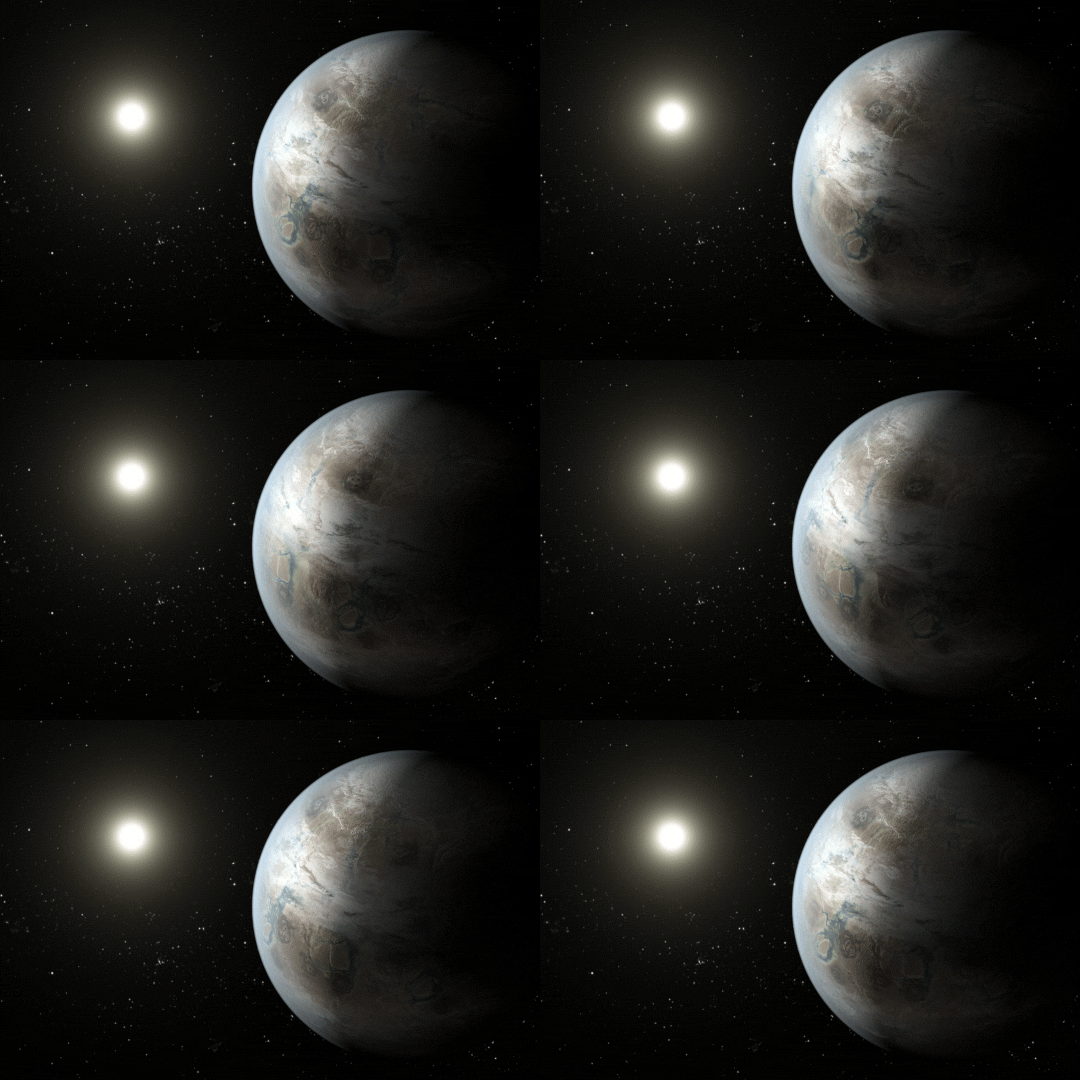


 GigiopixTumblr